
It is now generally accepted, even amongst die hard “Neo – Cons”, that when America and Britain invaded Iraq in March 2003 they did so based on a false prospectus using doubtful intelligence which had been hyped and spun. None of the substantive allegations made in the now infamous “Dodgy Dossier” have since proved to be correct. There were no “Weapons of Mass Destruction” (WMDs), no ability to attack British Bases (In Cyprus!) within 45 minutes; etc, etc, Large parts of the dossier, it has since emerged, had been lifted from a postgraduate student's thesis. Foreign Secretary Jack Straw said later that year he never saw the controversial "dodgy dossier" about Iraq's alleged weapons of mass destruction before it was published in February 2003. Mr Straw said the dossier was an "embarrassment" for the government and was commissioned by Downing Street communications director Alastair Campbell. He apologised to the student whose thesis was used as the basis of the "dodgy dossier", during questions from the Commons foreign affairs select committee. He however, defended the way the reports were made public, amid claims that Number 10 hyped up intelligence about Iraqi weapons. He admitted the whole "dodgy dossier" affair was "a complete Horlicks".
The initial strikes on 20 March 2003 were targeted at Saddam Hussein and his sons with little squeamishness about the civilians killed in the attack and afterwards the chaos which ensued with looting of museums and settling of scores represented a complete abdication of the responsibility required of Britain and America under the Geneva Conventions as “Occupying Powers.” Five years on there is a general consensus that the invasion has been disastrous and that Al-Qaeda has been extremely fortunate to have had the services of a recruiter of the calibre of George Walker Bush. And whilst there is little evidence to associate the religion of Islam with “terrorism” there is considerable evidence to associate the occupation of Arab lands with resistance. Indeed the Geneva Convention expressly recognises the right of occupied peoples to resist an occupier and whilst Bush’s now disgraced Attorney General found the Geneva Conventions “quaint” others as diverse as Colin Powell, John McCain and Jacques Chirac had pointed out that they had protected American soldiers in previous conflicts. Of course, the aforementioned Powell, McCain and Chirac had actually fought for their countries and experienced the brutality of war firsthand which is why they probably lacked the unencumbered strategic vision of a Bush, Cheney or Rumsfeld. Today, under the strict definitions of International Law, the only lands occupied by an “Occupying Power” are the West Bank of Palestine and Iraq, although I’m sure a case can be made for more.
The legality of the invasion of Iraq in 2003 has been debated fiercely. International lawyers and anti-war campaigners reacted with astonishment after the influential Pentagon hawk Richard Perle conceded that the invasion of Iraq had been illegal. In a startling break with the official White House and Downing Street lines, Mr Perle told an audience in London: "I think in this case international law stood in the way of doing the right thing." President George Bush has consistently argued that the war was legal either because of existing UN Security Council resolutions on Iraq - also the British government's publicly stated view - or as an act of self-defence permitted by international law. But Mr Perle, a key member of the defence policy board, which advises the US defence secretary, Donald Rumsfeld, said that "international law ... would have required us to leave Saddam Hussein alone", and this would have been morally unacceptable. French intransigence, he added, meant there had been "no practical mechanism consistent with the rules of the UN for dealing with Saddam Hussein". Mr Perle, who was speaking at an event organised by the Institute of Contemporary Arts in London, had argued loudly for the toppling of the Iraqi dictator since the end of the 1991 Gulf war.
The United Nations Secretary General, Kofi Annan, said In September 2004, that the decision to go to war without a second resolution was illegal. "I have indicated it was not in conformity with the UN charter from our point of view - from the charter point of view - it was illegal," he told the BBC. In his final speech as UN head, in late 2006, he again attacked US unilateralism, saying: "No nation can make itself secure by seeking supremacy over others."
 Ishtar Gate of Babylon
Whatever the immediate debates prior to the invasion of Iraq if Tony Blair et al. had more of an eye on British Colonial history they would have perhaps exercised more caution because, in an area which is highly competitive, Britain has a particularly disgraceful and unhappy history in Iraq and a well deserved reputation for double dealing in the region. Wiser counsel might have suggested that this was an area where it would be peculiarly difficult to intervene let alone be there as an occupying power for 5 years and counting. For it is Iraq that the British Army suffered its worst defeat in modern times at Kut – al – Amara.
Ottoman rule over Iraq lasted until World War I (1914-1918) when Britain conquered Iraq. In the tumbledown city of Kut -al -Amara south of Baghdad, a half-flooded cemetery is one of the few memorials to British control of Iraq. The tops of gravestones stick out of the slimy green water which obscures the names of some of the 40,000 British soldiers who died in Iraq in World War I. British rule over the three provinces which became present-day Iraq was never happy. In November 1914, a week after the Ottoman Empire had entered the war on the side of the Central Powers (Germany and Austria-Hungary), Indian Expeditionary Force ‘D’ landed at Fao in the southernmost province of Ottoman Iraq. Their subsequent occupation and de facto annexation of the area consolidated a connection with a region in which Britain had long been economically dominant.
Kut-al-Amara lies on the River Tigris at its confluence with the Shatt-al-Hai (a canal of ancient history), 120 miles upstream from the British positions at Amara and 500 miles upstream from the port of Basra. The town lies in a loop of the river with a small settlement on the opposite bank, and in 1915 was a densely-populated, filthy place. The civilian population was around 7000; many were evicted as the army fell back into the town. It had large local supplies of grain due its peacetime role as a marketplace.
At the time of this action, daytime temperatures had cooled and were no longer a problem; night was freezing. Following the unexpected repulse in front of Ctesiphon, the exhausted and depleted British force was urged back to the defences of Kut-al-Amara, which after an epic retreat was reached on 3rd December 1915.
From Whitehall - in full knowledge that it was going to be impossible to reinforce the army in Mesopotamia, given all of the other mounting demands - came advice to retire even further downstream. Unfortunately it came too late, for the 6th (Poona) Division was by this time besieged - and learning that 8 more Turkish Divisions, recently moved from Gallipoli now the British force had been defeated there, were massing near Baghdad. Divisional commander Charles Townshend was promised a rapid relief. He calculated that there were enough supplies in Kut to enable his force to hold out for a month: he was told it might take two months for the relief force to arrive. He sensibly suggested an attempt to break out and retire - but Sir John Nixon ordered him to remain and hold as many Turkish troops around Kut as possible. 10000 fighting men were bottled up in the town as the Turk units surrounded it and sealed off retreat; the boats - the vital lifeline back to Amara - got away just in time.
 Kut-al-Amara
Townshend at first kept the garrison on a full daily ration, fully confident that a relieving force would arrive. Several large-scale attacks by the Turks were beaten off, with high losses on both sides in December 1915. Meanwhile the attempt to assemble a force and advance to relieve the garrison failed in a series of bitterly-contested attacks in January and March 1916. The British lost a further 23000 men in the attempt, and the Turks around 10000. At one point, orders were prepared for an effort to break out of the siege. But by April 1916, the supplies had dwindled and the rate of sickness in the town had escalated to epidemic proportions. An attempt by the paddle steamer Julnar to reach the town by river failed after a valiant attempt. Small quantities of supplies were dropped from the air but it was nowhere near enough to save the garrison.
On 26th April 1916, after receiving approval from higher command and Governments, Townshend asked the Turks for a 6-day armistice and permission for 10 days food to be sent into the town. Khalil Pasha, Turkish commander, agreed and requested talks with Townshend the next day. During the talks, Khalil demanded unconditional surrender. Townshend offered a million pounds sterling, all the guns in the town and a promise that the men would not again engage in fighting the Turkish army. Khalil was of a mind to accept; Enver Pasha was not. He wanted a spectacular victory, inflicting as much damage to British prestige as possible. Meanwhile the garrison in Kut used the armistice time to destroy anything useful left in the town. On the 29th, Townshend surrendered. It was the greatest military disaster ever to have befallen the British Army.
But worse was to come. Townshend himself went into a comfortable if isolated captivity. The sick, unfit, undernourished men of the garrison were force-marched, many beaten savagely, many killed by acts of wanton cruelty. More than 3000 of those who surrendered at Kut were murdered by the Turks in this way, while in captivity. Those who survived were little more than skeletons when they were 2 years later released or exchanged. The British Army lost 227 British and 204 Indian officers and 12828 other ranks - of which 2592 were British - when the garrison surrendered. The Turks killed more than 1700 of the British other ranks and possibly as many as 3000 of the Indian troops, while in captivity. Losses during the fighting during the siege were approximately 2000 and the relieving force lost 23,000 in the attempt.
The decision to stand at Kut was a grave mistake: the initiative, until then always with the British in this campaign, passed to the Turks. The forces available to relieve the garrison were too few and too long in coming. The fact that the Tigris Corps, coming to the relief of the garrison, fought a splendid if ultimately unsuccessful campaign was to no avail. The loss of Kut and the Poona Division stunned the British Empire and her Allies and provided another huge morale boost for Turkey and Germany, especially coming so soon after Britain's ignominious withdrawal from Gallipoli. The need to relieve Kut drew more forces into Mesopotamia - what impact would this force have had if it had been deployed into the Western Front at this time, when British strength and reserves were still small?
 British War Memorial, Basra.
Eventually, reinforcements from Britain and the transfer of the military command to London made possible the capture of Baghdad in March 1917. In November 1918, a few days after the end of the war, the city of Mosul was occupied, and the surrounding province was also deemed to have fallen into British hands. When a much-reinforced British Army finally defeated the Turks, the UK was immediately faced with some of the problems still facing anybody seeking to rule Iraq today. Captain Arnold Wilson, the British civil commissioner in newly captured Baghdad, believed that the creation of the new state was a recipe for disaster. He warned that the deep differences between the three main communities - Sunni, Shia and Kurds - ensured it could only be "the antithesis of democratic government". This was because the Shia majority rejected domination by the Sunni minority, but "no form of government has been envisaged which does not involve Sunni domination.
After the British conquered much of the Middle East, they re-drew much of the boundaries not according to the Ottoman rule or to ethnic lines, but rather according to strategic objectives and various political agreements with France (such as the Sykes-Picot Agreement). As a result, much of the border issues that developed later in the twentieth century, such as between Iraq and Kuwait, between Iran and Iraq, and even between Syria and Turkey, were results of the British and French colonial powers arbritary drawing of the borders. The British established a kingdom in Iraq in 1921 and ruled under a mandate granted by the League of Nations. Britain chose the Hashemite family from Mecca (now in Saudi Arabia) to be the royal family in Iraq. The first king of Iraq was Faisal bin Hussein. Faisal remains something of an enigmatic figure; one of the great “what-ifs” of modern Middle Eastern history is the rather different course which Iraqi history might have taken if Faisal had still been alive in the 1950s (his father died at 79, his brother was 71 when he was assassinated in 1951) rather than dying twenty years earlier. Faisal was vital in the creation of Iraqi identity; he was a genuine war hero and came with a certain reputation both from the Arab revolt and from Syria. In addition, his descent from the Prophet gave him a certain cachet in the eyes of the Shia. All this and more is captured in David Lean’s portrayal of the relationship between Faisal and Colonel T.E. Lawrence in the film “Lawrence of Arabia.”
 Feisal's Party at Versailles - Lawrence on his right
His successors were fashioned from much coarser clay; his son Ghazi (born 1912, reigned 1933-39), was a lightweight; his nephew, the Regent ‘Abd al-Ilah (1913-1958, effectively on the throne between 1939 and 1958), was widely hated for his slavish obedience to Britain. His more innocent grandson Faysal II (1935-58) was so tarred with his uncle’s brush that neither of them stood much of a chance against the revolutionaries who came for them and for Nuri al-Sa’id in July 1958.
The merging of the three Ottoman provinces of Mosul, Baghdad, and Basra into one political entity and the creation of a nation out of the diverse religious and ethnic elements inhabiting these lands was accomplished after World War I. Action undertaken by the British military authorities during the war and the upsurge of nationalism after the war helped determine the shape of the new Iraqi state and the course of events during the post-war years, until Iraq finally emerged as an independent political entity in 1932.
British control of Iraq, however, was short-lived. After the war, Britain debated both its general policy in Iraq and the specific type of administration to establish. Britain was still undecided on which policy it should follow in 1920 when events in other Arab countries radically changed conditions in Iraq. Under the influence of nationalists a revolt started in the town of Rumaitha in the middle Euphrates.The national agitation followed that revolt into the tribal areas of the middle Euphrates and in northern Iraq. By the July of 1920 the revolt had spread to all parts of the country except the big cities of Mosul, Baghdad, and Basra, where British forces were stationed.
 Faisal in Paris 1918
The causes of the revolt were diverse. Arab nationalists wanted independence. Officials who worked for the Turks were marginalised. The Shia clergy disliked the new authorities because they were Christian. The tribesmen were resentful that the British were more effective than the Turks in collecting taxes. The centre of the revolt was the middle Euphrates. By the time British rule was restored in 1921, some 2,000 British soldiers and 8,000 Iraqis had been killed or wounded. In the wake of the rebellion, the UK tried to rule Iraq cheaply and at one remove.
Britain provided Faisal with RAF bombers, armoured car squadrons and officers to lead the local conscripts, with which to respond to any insubordination on the part of the local population. Any uprising was handled by the bombers, which first dropped warning leaflets on the illiterate villagers and then bombed property and livestock. Bombing was even used to terrorise the peasants into paying taxes. One the largest offensive operations mounted by the RAF was in 1923-24 in Southern Iraq. The tribal leaders responsible for collecting taxes from the semi-nomadic tribesmen and the peasants, who had become increasingly impoverished due to the diversion of the water channels by the most powerful sheikh, refused to pay up. The RAF was ordered to bomb the area in order “to encourage obedience to the government”.
Over a two-week period, 144 were killed and many more were wounded. It was by no means an isolated incident. The RAF was used repeatedly in 1923-34 against the Kurds in Mosul province, who rebelled against taxation and conscription. One officer who had seen duty in the North West Frontier—no stranger to British brutality—feared that air control would only serve to inflame the situation: “Much needless cruelty is necessarily inflicted, which in many cases will not cower the tribesmen, but implant in them undying hatred and a desire for revenge. The policy weakens the tribesman’s faith in British fair play.” But the British played anything but fair. One report to the Colonial office described an air raid in which men, women and children had been machine-gunned as they fled from a village. The politicians took care to ensure that the British public never learned about that incident.

Faisal was always dependent on British support. He and his descendents never succeeded in establishing their nationalist credentials in Iraqi eyes. The British also wanted to reduce the cost of ruling Iraq by relying on air power rather than expensive ground troops. It was a testing ground for the Royal Air Force. Arthur "Bomber" Harris, who was to lead the bomber offensive against Germany 20 years later, did not conceal the fact that he aimed at civilian targets. Harris said in 1924 that he had taught Iraqis "that within 45 minutes a full-sized village can be practically wiped out and a third of its inhabitants killed or wounded".
Some other British leaders were equally blood-thirsty. After the revolt of 1920, TE Lawrence - Lawrence of Arabia - wrote to the London Observer to say: "It is odd that we do not use poison gas on these occasions."
Although the revolt in Iraq was suppressed by force, it prompted Iraq and Great Britain to reconcile their differences. In Britain a segment of public opinion wanted to "get out of Mesopotamia" and urged relief from further commitments. In Iraq the nationalists were demanding independence.
 US Soldiers by The Lion of Babylon
In 1921 Britain offered the Iraqi throne to Faisal along with the establishment of an Arab government under British mandate. Faisal wanted the throne if it were offered to him by the Iraqi people. He also suggested the replacement of the mandate by a treaty of alliance. These proposals were accepted by the British government, and Winston Churchill, then colonial secretary, promised to carry them out. He was advised by T.E. Lawrence, (Lawrence of Arabia, who had been seconded to Faisal’s “Arab Army” during the fight against the Ottomans as his de facto military commander) known for his sympathy for the Arabs. In March 1921 a conference presided over by Churchill was held in Cairo to settle Middle Eastern affairs. Faisal was nominated to the Iraqi throne with the provision that a plebiscite be held to confirm the nomination. Sir Percy Cox, recently appointed a high commissioner for Iraq, was responsible for carrying out the plebiscite. A provisional government set up by Cox shortly before the Cairo Conference passed a resolution on July 11, 1921, declaring Faisal king of Iraq, provided that his "Government shall be constitutional, representative and democratic." The plebiscite confirmed this proclamation, and Faisal was formally crowned king on Aug. 23, 1921.
A new treaty was signed on June 30, 1930. It provided for the establishment of a "close alliance" between Britain and Iraq with "full and frank consultation between them in all matters of foreign policy which may affect their common interests." Iraq would maintain internal order and defend itself against foreign aggression, supported by Britain. Any dispute between Iraq and a third state involving the risk of war was to be discussed with Britain in the hope of a settlement in accordance with the Covenant of the League of Nations. In the event of an imminent threat of war, the two parties would take a common defence position. Iraq recognized that the maintenance and protection of essential British communications was in the interest of both parties. Air-base sites for British troops were therefore granted near Basra and west of the Euphrates, but these forces "shall not constitute in any manner an occupation, and will in no way prejudice the sovereign rights of Iraq." This treaty, valid for 25 years, was to come into effect after Iraq joined the League of Nations. On Oct. 3, 1932, Iraq was admitted to the League of Nations as an independent state.
 Baghdad 1890
Iraq became formally independent in 1932, but British influence, though diminishing, remained important. During the 1930s, the Sunni ruling clique’s dependence upon Britain became ever more difficult to square with popular sentiment. The Iraqi nationalists resented the IPC’s control of Iraqi oil, while the peasants and urban workers became increasingly impoverished. British policy in Palestine—its support for a Jewish homeland, Jewish immigration and the suppression of the Arab Revolt 1936-39—served to inflame tensions even further.
This led some of the Iraqi politicians and the military that had become increasingly powerful making and breaking governments to orientate towards Nazi Germany. In part this was due to a belief that it would free Iraq from the hated British, but in part it expressed political sympathy with fascism and its exploitation of anti-Semitism, fuelled by the situation in Palestine and the British cultivation of the Jewish financiers in Iraq. This was further exacerbated with the arrival in Baghdad in 1939 of Hajj Amin al-Husseini, the Palestinian nationalist leader, who had fled from the British. In 1941 Rashid Ali, a former Ottoman officer, became prime minister, backed by four army colonels. Encouraged by Hitler's victories in Europe, the new government sought to whittle away at British imperial control. The British denounced the government’s action as a revolt and sent forces from Transjordan and India to Basra, overthrew Rashid Ali and restored Nuri al-Said and the regent to power. After that, with British troops occupying southern Iraq, the government cooperated fully with the British war effort. The following year Britain was able to use it as a base from which to invade Syria and Persia where it installed a pro-British government to support its war effort. In 1943, Nuri al-Said’s Iraq declared war on the Axis powers.
After World War II, the alliance with Britain carried increasing dangers for the Hashemite government as the influence of Arab nationalism increased throughout the Middle East. Although Britain emerged from World War II with its empire in the Middle East intact, it faced very different conditions to those of 1939. The pattern of oil production had changed dramatically and by 1951 the Middle East was providing 70 percent of the West’s oil.
 On Patrol in Iraq 2006
Most of the world’s oil reserves were believed to be concentrated in Saudi Arabia and the Persian Gulf. But at the same time as the region’s value was becoming ever more important, Britain faced rising political ferment in the emerging working class. In Palestine, Soviet and American backing for a Zionist state as a way of undermining British influence in the region and the widespread horror at the tragedy that had befallen the Jewish people at the hands of the Nazis had paved the way for the United Nations vote in favour of the partition of Palestine and the establishment of the state of Israel. It incensed the Arab world. In Iraq, Egypt and Iran, where Britain’s highhanded actions in 1942 mirrored that against Rashid Ali, almost all social layers were desperate to throw off the yoke of imperialist rule.
The incoming Labour government under Clement Attlee was no more adept at judging the political tempo in Baghdad than that of the arch imperialist Winston Churchill. When the terms of the treaty that Saleh Jabr and Nuri al-Said had agreed with Britain in January 1948—which would have extended the hated 1930 Anglo-Iraqi Treaty for another 20 years—became known, students, workers and starving townspeople poured onto the streets in protest. The police were only able to suppress the riots with an orgy of brutality that killed nearly 400 people in just one day. Nevertheless the regent was forced to repudiate the treaty. Saleh Jabr resigned and the incoming government inaugurated the most savage era of repression and martial law. Britain’s model for restructuring its alliances in the Middle East policy was in tatters. The last two airbases controlled by Britain were handed back to Iraq in 1955. But three years later, the last British influence was removed when a military coup overthrew the Hashemite dynasty. In the subsequent power struggles, Saddam Hussein worked his way up through the ranks - a rise supported by the West, anxious to preserve its influence in the region.
In February 1955, Nuri al-Said played host to the British-organised regional security alliance of Turkey, Iran, Pakistan and Iraq, known as the Baghdad Pact, that completed a network of alliances spanning the southern rim of Eurasia aimed at containing the Soviet Union. It represented a bid by the British to offset their declining power and give them a say in regional affairs. It was no more acceptable to the Iraqis than the 1948 treaty had been. The other Arab countries would have nothing to do with it. Egypt’s President Nasser, who was becoming a hero in the Arab world for his opposition to the British, denounced the pact vehemently as an attempt by Britain to assert its domination over the region and split the Arab world.
The Anglo-French military campaign in support of the invasion by Israel of the Suez Canal in 1956, aimed at getting rid of Nasser and reinstating Anglo-French control of Suez, outraged the Iraqi people. There were massive anti-British demonstrations all over Iraq. No one doubted for a minute that Nuri al-Said and the regent supported the British. Notwithstanding some face-saving formal protests to Britain, the Iraqi government clamped down violently on the demonstrations and once again resorted to martial law. In July 1958, as tensions and mass demonstrations against the regime mounted, a military group known as the Free Officers overthrew Britain’s venal political agents, the Hashemite monarchy of Faisal II and the government of Prime Minister Nuri al-Said, in a military coup.
 Nuri al-Said and Crown Prince Abdul
 King Faisal II of Iraq
 Arab Summit Beiruit 1956
The royal family and Nuri were assassinated. Such was the loathing of the ancien regime that his naked body was dragged ignominiously through the streets of Baghdad until it was reduced to pulp.
In the eyes of most Iraqi’s forty years of brutal exploitation and political repression by the British and their collaborators had come to an end. Forty-five years on from these events, the defeat of Saddam Hussein and the Ba’athist regime, by the US with Britain as its junior partner, signified the return of direct foreign control and the most brutal forms of repression and exploitation that the Iraqi people thought they had got rid of in 1958. It is already apparent that many of the events of the past five years could have come straight from the records of the first colonial occupation of Iraq.
Look, for example, how the west egged on Saddam to invade Iran in 1980, how we patronised him for eight terrible years with export credits and guns and aircraft and chemicals for gas. Indeed when Donald Rumsfeld first met Saddam he was selling him weapons. Looking back now, we were doing something else. By supporting Saddam's war, we were helping an entire generation of Iraqis to learn to fight--and die.
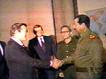 Rumsfeld and Saddam 1983
The lessons of history show firstly that the US will—with UN endorsement—impose a military occupation fronted by some corrupt émigrés, former Ba’athist and anyone else who can be bought to enable US corporations to take charge of Iraq’s oil industry. Secondly, the US’s determination to control the world’s most strategic resources will lead to further invasions and occupations. But the disaster of Iraq is not just a disaster FOR Iraq but for the Middle East and the wider cause of stability and peace in the world: The Independent’s fearless correspondent Robert Fisk summed it up in a recent interview with the ABC news network.
“Well, sure, there is a mosque war going on in Iraq with the Americans up to their feet in the sand, there's an Iranian crisis, or so we're told, the Saudis are frightened the Iraq war will spill over into Saudi Arabia, the Egyptians don't know how to reconcile Syria and Lebanon, there are increasing sectarian tensions here in Lebanon. You would think that someone is building what used to be called Potemkin villages, you know, these extraordinary things that Catherine the Great's court favourites use to build, facades of villages, so that everything looked nice in Russia even though things were barbarous behind the facades. I mean, this is a barbarous world we're living in now in the Middle East. It's never been so dangerous here, either for journalists or soldiers but most of all for Arabs. Hence the thousands of people in the mortuary.”
 Rev. Anthony Lyndon Blair, Vicar of St. Albion on holiday
A better understanding of history would indicate that Britain and the US are the two powers least likely to succeed in “intervening” in Iraq and the Middle East. It might indicate to Tony Blair that, whatever his other qualities, he is the person “Least likely to succeed” as Middle East Peace envoy. Indeed with the launch of his Faith Foundation he might reflect on the words of someone else who had to conceal his Catholic Faith whilst he held public office, the poet Alexander Pope, whose words from 1711 in his An Essay on Criticism still ring true:
"For fools rush in where angels fear to tread"


