Showing posts with label Great Missenden. Show all posts

Monday, April 4, 2011

Pray and Display


Signs in the car park of the Catholic Church in Great Missenden, Buckinghamshire. Not sure what evidence you can give if you get a ticket but finding evidence is always the problem with religion!

Great Missenden at the head of the Misbourne valley is an attractive small town, with a long curving High Street of half timbered and Georgian shops, a graciously proportioned Baptist Church and a number of traditional pubs.


Roald Dahl Museum and Story Centre, Great Missenden

Church Street is full of interesting old houses and leads, via a bridge over the by - pass, to the mainly 14th century Parish Church of St. Peter and St. Paul. Missenden Abbey, founded in 1133 as an Augustinian monastery, is now a residential college offering adult education courses.


Chiltern Hills

Great Missenden has been host to a variety of famous people over the centuries, including Robert Louis Stevenson (author of Treasure Island). The village is now best known as home to the late Roald Dahl, the internationally famous children's author.

Roald Dahl (13 September 1916 23 November 1990) was a British novelist, short story writer and screenwriter, born in Wales of Norwegian parents, who rose to prominence in the 1940s with works for both children and adults, and became one of the world's bestselling authors.


Roald Dahl

His most popular books include The Twits, Charlie and the Chocolate Factory, James and the Giant Peach, Matilda, The Witches and The BFG. Roald Dahl’s grave is in the graveyard of St. Peter and St Paul Church, Great Missenden. It is covered with a slab of Welsh slate as he grew up in Swansea and a small Norwegian flag is on the grave acknowledging the land of his forefathers. As you go to the grave at the edge of the path, you see an enormous footprint, pointing in the direction of Roald Dahl's grave. Then there are 3 more of these (concrete) footprints in the grass that lead right to his stone. These are footprints of a character in one of his books, The BFG - The Big, Friendly Giant. So it was like the BFG was either visiting his grave or had laid him in it!!


Roald Dahl's Grave St. Peter and St Paul Church, Great Missenden

For the museum devoted to Great Missenden’s most famous resident Roald Dahl see;

http://daithaic.blogspot.com/2008/01/roald-dahl-museum-and-story-centre.html


For scenes of Spring in the Chiltern Hills see;

http://daithaic.blogspot.com/2009/04/chiltern-spring.html


Monday, July 6, 2009

A Steamy Day in the Chiltern Hills


Last Sunday was a perfect sunny summer afternoon in the Chiltern Hills, an Area of Outstanding Natural Beauty (AONB) just 30 miles north west of London.

http://daithaic.blogspot.com/2009/03/rupert-brooke-and-chilterns.html

AONB is one step down from a National Park designation and provides tight control on development and farming. This was an aspect we certainly appreciated as we headed down the lovely Missbourne Valley towards Prestwood, a hamlet in the hills about a mile from Great Missenden

http://daithaic.blogspot.com/2008/01/roald-dahl-museum-and-story-centre.html

on the road towards High Wycombe. First order of business was to work up an appetite by visiting the Steam Fair at Prestwood followed by a superb barbie prepared by a Suid Afrikan Braiemeister washed down with oodles of Pimms No. 1. Dankie as they say in Cape Dutch!

The Prestwood Steam Fair is something of a Chiltern institution held at the beginning of July in the scenic environs of The Hangings at Prestwood and organised by the Chiltern Traction Engine Club. It is very much a major event for the aficionados with Steam Engines arriving all week beforehand with their “Living Vans” in tow. Don’t show yourself up in the presence of steamers by calling them “trailers”!


There is considerable variety at the fair with the attractions including around 40 Traction Engines, and Vintage vehicles including Cars, Motor Cycles, Lorries, Tractors and Stationary Engines. There is a Model and Craft tents, a Children's fun fair, a Children’s Farm and a large market with stalls selling clothes, toys and games, bric-a-brac, tools, auto jumble, etc. A working area with Steam Traction Engines demonstrates how they would have been used in days gone by when they would have earned their keep on the farms, estates and highways and byways of Britain. On site catering includes a licensed bar, burgers and fish and chips, a hog roast, doughnuts and jacket potatoes so there is a real fair athmosphere with many camping on site for the weekend in tents, caravans and trailer homes so Prestwood becomes a village and marketplace for the preservation community. Indeed their enthusiasm is catching for the whole event is avery real and dynamic exposition of an important part of Britain’s heritage in engineering and industrial design, a heritage which created our modern world.


A Living van


Morris delivery van

From time immemorial, the fastest way to travel on land was on horseback - but the advent of steam power for the mining industry in the later 18th century led to its adaptation to the movement of goods and people across the world. Britain was at the forefront of this technology and the first successful self-moving machines were introduced on the mineral railroads for iron and coal mining 200 years ago. The rapid development of steam technology led to the age of railway mania in the 19th century when many thousands of miles of railways were built in the UK alone.


The same technology was applied to road transport and the first self-moving traction engine was built around 1860. Rapid development saw many traction engine builders spring up, though most were in the east of England, with others in the industrial heartland of Yorkshire. To improve the roads, steam rollers were made. From the 1850s to the 1930s, steam was applied not only to roads but to agriculture as well, many engines - self-moving or not - being used to mechanise farming.


Meanwhile, steam power's hold on industry was growing, with huge beam engines used to pump out deep mines, or to raise fresh water or foul. Massive horizontal engines drove cotton mills, mainly in Lancashire and Yorkshire, while steamships plied the oceans of the world; all this made Britain 'great'. Around 100 years ago, the steam engine was adapted for leisure purposes and was a boon to travelling fairgrounds, both hauling and driving their rides.


Foden Steam Waggon


Foden Estate Tractor

After the First World War, a glut of surplus petrol-engined Lorries became available and these gradually took over road haulage from the 1920s, especially as steam was legislated against. Later, the diesel engine took over from petrol, and road haulage from rail as the country's rail network was slashed. This has left a legacy of superbly restored 'classic' Lorries which we can enjoy today while we wonder at the progress made in only a few short decades.


BMW Iseta Bubble Car


Blackstone Stationary Engine


We are fortunate that much of Britain's rich transport, agricultural and industrial heritage is preserved in working order, and many enthusiasts give freely of their time to keep it so. Every weekend in the summer numerous shows and open days are held around the country where many thousands of visitors can enjoy these superb relics of a bygone age and marvel at the engineering which once put the 'great' into Great Britain in the days when Birmingham claimed to be the workshop of the world, Wolverhampton the toolbox of the world and a quarter of the world’s ships were built on the River Clyde alone.


Steam Carousel


"Local Bus"

The Prestwood Steam Fair is a joyous family celebration of this heritage. Indeed even the wonderful carousel and organ is steam powered as are many of the side attractions. I did wonder about the Stationary Engines display which consisted of engines pumping water nowhere, milking machines powered by them with no cows attached and sheep shearing clippers with no scared sheep in sight. Behind these stationary engines were the proud owners and their families in tents inhaling the benzene fumes from their little motors! More satisfying were the displays of vintage cars including a BMW bubble car and nearly every model by Morris Garages in Oxford or MG as the marque was better known.


But for me the highlight was the exhibit of these fine beasts of the steam world actually earning their keep with a belt on their huge fly wheels harnessed to fearsome band saws, crushers and threshers which allowed you to appreciate their power and utility. Finally to the ring for the Grand Finale – the parade of these wonderful engines in all their finery like a herd of hissing mechanical Leviathans. Seeing them in all their finery and power I could understand why the steam enthusiast’s magazine is titled “Old Glory.”


The Grand Line Up


As I walked away from the Fair on this glorious summer’s afternoon in the Chiltern Hills the thought occurred that there are worse ways to work up an appetite for a barbie. There is something about steam which people identify with – I think this is because it is the last advanced technology whose inner workings are visible and easily understood by everybody. if you fancy a unique and fascinating event on the first weekend of July next year in the lovely Chilterns you could do worse than make a beeline for the Prestwood Steam Fair.

The Chiltern Steam Rally is held at Prestwood, on the A4128 between Great Missenden and High Wycombe

The Hangings, Honor End Lane, Prestwood,
Great Missenden, Buckinghamshire, HP16 9HQ


Thanks for the photographs to a talented architect, designer and photographer who let me use his shots.

www.tri-linear.org

This was not the intention but when I took out my camera I had forgotten to insert a power pack. Modern Technology!

Tuesday, January 1, 2008

Roald Dahl Museum and Story Centre


Roald Dahl Museum and Story Centre

Not far from us is the Chiltern Village of Great Missenden where the famous author Roald Dahl lived until his death in 1990. The Roald Dahl Museum and Story Centre is in the High Street of this picturesque village set in the Missbourne Valley. This great little Museum has two fun and fact-packed biographical galleries and a fantabulous Story Centre. In Boy and Solo, visitors can learn about the events that shaped Roald Dahl as a writer, from his illicit motorbike outings at school to his time as a World War Two fighter pilot.

In the Story Centre, visitors can get creative with plot, character and language and discover how writers from J.K. Rowling to Benjamin Zephaniah write. Visitors can also explore a replica of Roald Dahl's famous Writing Hut, sit in his writing chair and get some gloriumptious story ideas.


Half of the Museum tells the fascinating story of Roald Dahl’s life. The other half focuses on the process of creative writing. The displays include original documents, a replica of Roald Dahl's writing hut, top tips from today's leading authors and lots of interactive games. Perfect to spark the imaginations of 6 to 12 year olds and their families. Visitors usually stay for between one hour and 90 minutes though many stay longer, particularly if they join in one of the activities or enjoy a snack in the "Twits Cafe".

Roald Dahl (13 September 1916 – 23 November 1990) was a British novelist, short story author and screenwriter of Norwegian parentage, who rose to prominence in the 1940s as a writer for both children and adults. His most popular books include Charlie and the Chocolate Factory, James and the Giant Peach, Matilda, The Witches and The BFG.


Wonka's Chocolate Factory

As recounted in Boy, Roald Dahl's father, Harald Dahl, immigrated to England from Norway around the turn of the century (1900). Not long after the death of his first wife, he took a trip back to Norway in hopes of finding a wife to help him raise his young son and daughter. He married Sofie Magdalene Hesselberg in 1911 and the couple moved to Dahl's home in Llandaff, Wales. Over the next six years they had five children: Astri, Alfhild, Roald, Else, Asta. Roald was born on September 13, 1916 in Llandaff. Unfortunately Astri, the eldest, died of appendicitis in 1920. Harald Dahl quickly deteriorated after his daughter's death and he died of pneumonia a few months later. Sofie Dahl, pregnant at the time with Asta, was left with three of her own children, two step–children, a sizeable estate, and her husband's dying wish that his children would be educated in English schools, which he thought the best in the world.


At eighteen, instead of entering university, Dahl joined an expedition to Newfoundland. Returning to England he took a job with Shell, working in London (1933-37) and in Dar es Salaam, Tanzania (1937-39). During World War II he served in the Royal Air Forces in Libya, Greece, and Syria. He was shot down in Libya, wounded in Syria, and then posted to Washington as an assistant air attaché to British Security (1942-43). In 1943 he was a wing commander and worked until 1945 for British Security Co-ordination in North America.

There are macabre twists and unexpected cruelty by characters in both his adult and children’s writing and it is likely his wartime experiences which included being shot down and captured, his serious injuries which necessitated 6 months hospitalisation in Alexandria, Egypt and death being omnipresent contributed to his sardonic view which finds expression in his writing. Death was also omnipresent with most of his squadron being shot down in slaughterhouse air battles such as the battle of Athens in 1941 and Dahl himself was credited with 22 enemy kills during the war. The cold eye he cast on life is probably due to his wartime experience and the part disease played in his own and his family’s life later.

Boy – Tales of Childhood and Going Solo are accounts of Dahl's childhood experiences which explain where some of the ideas for his books originated. Roald Dahl and his siblings were raised to be very conscious of their Norwegian heritage. Not only did his mother speak the language around the house, she also read them Norse myths and took them on annual trips to Norway to visit relatives. This heritage is most evident in Dahl's book The Witches, but its influence can be seen in other books as well.


Roald Dahl's writing chair

Danny, The Champion of the World, Matilda, and Roald Dahl's Revolting Rhymes are examples of stories resulting from Dahl's beliefs that "The writer for children must be a jokey sort of fellow... he must be unconventional and inventive." Of children, he said, "They love being spooked... They love chocolates and toys and money... They love being made to giggle." The stories of Roald Dahl are indeed treasures for children and for generations to come. Famous for his ingenious short stories and macabre children's books, Dahl's taste for cruelty, rudeness to adults, and the comic grotesque fascinated young readers, but upset many adult critics. Several of Dahl's stories have been made into films, including Matilda, dir. by Danny DeVito (1996).

'Aunt Glosspan,' the boy said, ' what do ordinary people eat that we don't?'
'Animals,' she answered, tossing her head in disgust.
'You mean live animals?'
'No,' she said. 'Dead ones.'
(from 'Pig' in Kiss, Kiss, 1959)

Roald Dahl died in November 1990 at the age of 74 of a rare blood disease, myelodysplastic anemia, at his home, Gipsy House in Great Missenden, Buckinghamshire, and was buried in the cemetery at the parish church of Saint Peter and Saint Paul. According to his granddaughter, the family gave him a "sort of Viking funeral". He was buried with his snooker cues, some very good burgundy, chocolates, HB pencils and a power saw." In his honour, the Roald Dahl Children's Gallery was opened at Buckinghamshire County Museum in nearby Aylesbury.
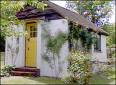

The Writing Hut, Gipsy House, Great Missenden

Dahl's charitable commitments in the fields of neurology, haematology and literacy have been continued by his widow since his death, through the Roald Dahl Foundation. In June 2005, the Roald Dahl Museum and Story Centre opened in Great Missenden to celebrate the work of Roald Dahl and advance his work in literacy. Felicity Dahl still lives at Gypsy House and its grounds (and Dahl’s writing shed) are open 5 times a year in aid of the various charities he supported.

The museum is set in an old coaching inn at 81-83, High Street, Great Missenden and is a welcome addition to a village which, though it has gentrified somewhat, still has the atmosphere of a typical Chilterns village set in a wooded valley in the Hills which first attracted Roald Dahl here. The museum offers a pleasant thematic journey through his life and work in the various exhibits and in the Story Centre which is designed to encourage children’s creativity. It has a well stocked shop which shows how easily his books (and the movie spin offs) lends themselves to merchandising. The well run “Twit’s Café” offers a pleasant informal pit stop for children and harassed parents alike!


St. Peter and St Paul


Great Missenden from St. Peter and St Paul Church


If you walk past the museum away from the railway station you will come to Church Street. Walk about 250 yards along this you will come to the parish church of St. Peter and St Paul. There is evidence of a church here since 1133 and typically of the Chiltern villages the church is just outside the town, probably due to the incidence of burials due to Plague and “Fever” in the early middle ages. Roald Dahl is buried here with his grave marked by a slab of Welsh
slate.


The bench you see in the background has a quote from one of his children's books. Then, at the edge, you see an enormous footprint, pointing in the direction of Roald Dahl's grave. Then there are 3 more of these (concrete) footprints in the grass that lead right to his stone. These are footprints of a character in one of his books, The BFG - The Big, Friendly Giant. So it was like the BFG was either visiting his grave or had laid him in it!!


Roald Dahl's Grave

The Roald Dahl Museum and Story Centre
81-83 High Street, Great Missenden,
Bucks HP16 0AL

www.roalddahlmuseum.org